
PROTOCOL NOTES / 05
Control & link health
Prove identity, authorize actions, and test the return path.
Implemented software · Physical qualification pending
Transport proof comes before engine hello
TLS 1.3 uses self-signed Ed25519 certificates to prove possession; outgoing connections pin the discovered expected identity. Session tickets and caching are disabled. A length-prefixed transport greeting exchanges protocol version, nonzero UDP media port, opposite directions, and attempt ID.
Engine hello then checks the ride, version, admission token, and membership rules. Both transport/greeting and hello have bounded establishment deadlines. A valid hello starts direct health tracking; it does not turn a standby edge into an active media path.
Measure a round trip, not just incoming traffic
| Event | Configured behavior |
|---|---|
| Ping interval | 1 second; signed direct neighbor exchange, never flooded |
| Suspect | 3 seconds without the required round-trip evidence |
| Dead | 6 seconds; close and repair the affected link |
| Recovery | Two valid round trips; a pong consumes one outstanding token |
| Hello timeout | 5 seconds for an establishing protocol peer |
Incoming audio is not sufficient proof that a control path works in both directions. Likewise, silence is not proof of a failed connection. Each pong must match a currently outstanding, single-use ping. These values are implemented software defaults, not qualified radio thresholds.
Repair the affected scope
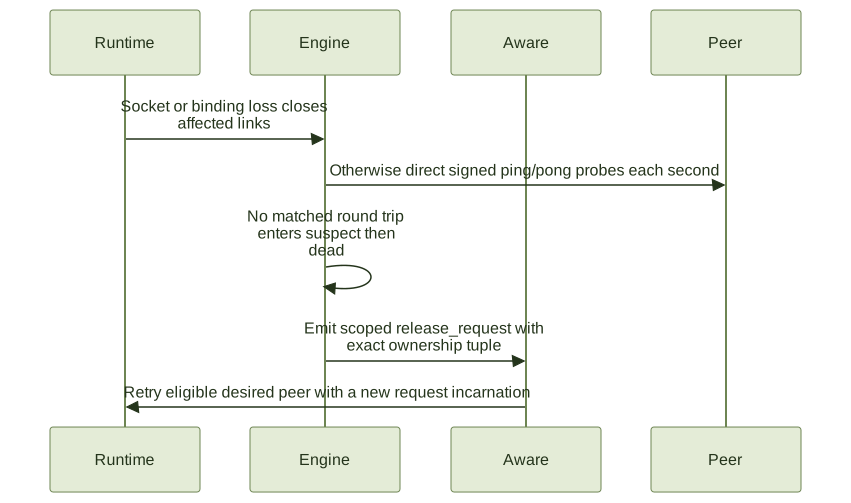
A failed peer does not invalidate every binding on a shared interface. Reasoned state transitions feed diagnostics while reconnection uses the current session and route generation.
Authority: Wire reference; direct link liveness. Public examples are synthetic. This guide is maintained against the private implementation; it does not imply access to its source.